No-KYC Bitcoin Cards
Cards operable without identity verification - and the honest trade-offs: higher counterparty risk, no regulator.
cards on this page: 3 · issuing today (excl. watch list): 3 · verified or reported facts: 0% · direct on-chain BTC top-up: 3
quick picks
- the most documented no-KYC operator Freedomia - every fee and limit published in plain text - 1.3% USDT/USDC top-up, 2.5% FX, $5/month, $5,000/mo per card, sanctioned-country blocklist; the transparency standard for the lane
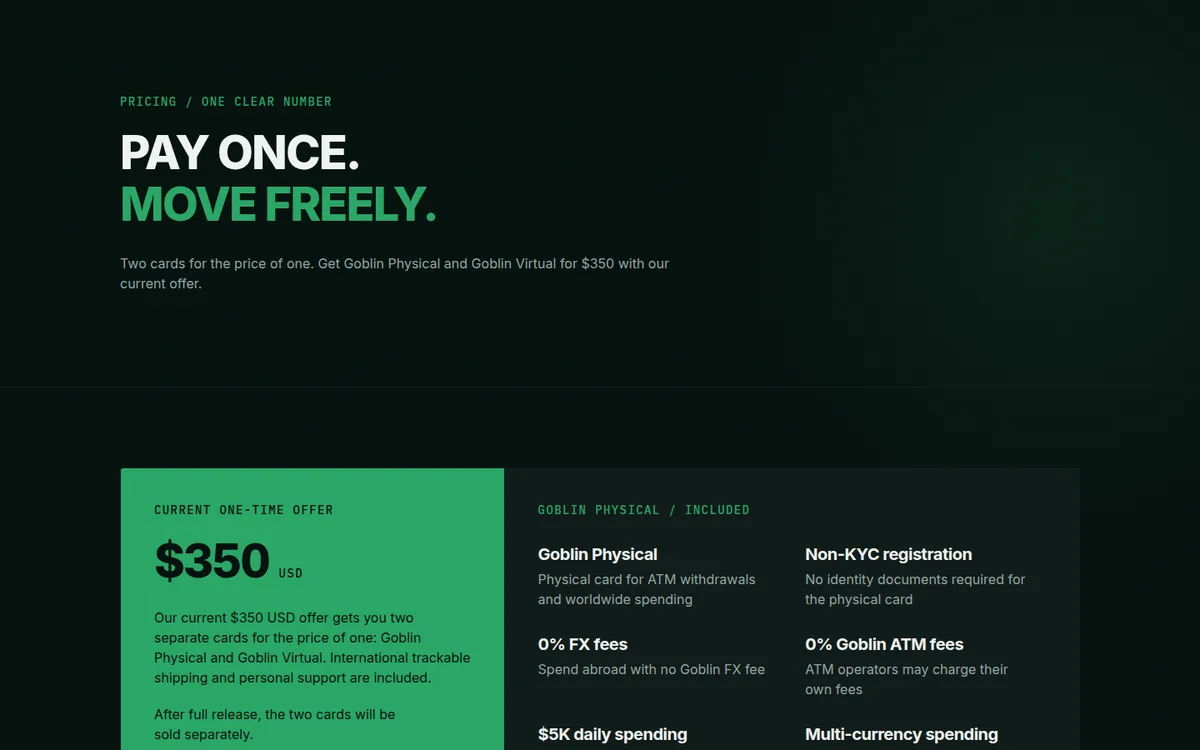
- physical plastic without identity documents Goblin Card - $350 one-time for physical + virtual, tracked international shipping included, 0% FX on physical, BTC, ETH, SOL and USDT funding - the only plastic in the lane
- the cheapest entry with a money-back caveat 2Fiat - virtual Mastercard with instant details, $10-$10,000 loads, refundable minus $10 - but the operator entity stays undisclosed and fees are user-reported, not published
Short answer: 3 live cards operate without KYC inside published limits. Freedomia is the strongest we track - every fee published in plain text (1.3% top-up, $5/month, $5,000/mo ceilings), Lightning funding, about a year in operation - but its card issuer stays undisclosed: load spending money, never savings. Goblin covers physical plastic; 2fiat is the bare-bones entry.
| # | Card | Bitcoin in | BTC sold | KYC | Monthly | Cashback | Pay & Cash | Score | |
|---|---|---|---|---|---|---|---|---|---|
| 1 |  Freedomia Direct BTC top-up (on-chain) |
On-chain | At top-up | None | $5 | – | Google Pay ATM | 7.3 | Visit |
| 2 |  Goblin Card Direct BTC top-up (on-chain) |
On-chain | – | None | $0 | – | Apple Pay Google Pay ATM | 5.9 | Visit |
| 3 |  2Fiat Direct BTC top-up (on-chain) |
On-chain | – | None | $0 | – | Apple Pay Google Pay | 5.5 | Visit |
The no-KYC lane is the smallest and most honest population on this site: 3 live cards, every one of them with a published ceiling that exists because regulation - not preference - sets the boundary. Identity obligations attach above trigger levels, so no-KYC products live hard-capped underneath them, price their compliance risk into visible fees, and carry a counterparty profile that no KYC operator would be allowed to have. This page documents that trade in full, because the users who want it already know the basics and deserve better than the usual "private and anonymous" fog.
The three operators, compared
Freedomia is the lane's transparency standard: every fee and limit in writing - $5/month (Founder) or $9.99/month (HODL), 1.3% on USDT/USDC Polygon deposits, 2.5% FX, $5,000/month per card, Lightning and on-chain funding, and an explicit sanctioned-country blocklist (Belarus through Venezuela, plus five Ukraine regions) [see the Freedomia review]. The no-KYC claim is precise: no KYC within the standard limits.
Goblin Cards is the plastic option: $350 one-time buys the physical card and the virtual, tracked international shipping included, "no identity documents required for the physical card" [3]. The fee curve is the lane's steepest - 3.5% BTC deposits, $100 minimum - but the FX story is clean: 0% Goblin FX on physical, with the virtual's ~1.5% total difference documented as a 1% markup inside the conversion rate [see the Goblin review].
| Card | BTC in | FX | ATM | Monthly | KYC | Custody | Status |
|---|---|---|---|---|---|---|---|
| Freedomia | On-chain | 2.5% | 3.5% + $NaN | $5/mo | None | custodial | active |
| Goblin Card | On-chain | 0% | 2% + $NaN | $0/mo | None | custodial | active |
| 2Fiat | On-chain | 2.5% | $NaN | $0/mo | None | custodial | active |
Live values from our database - details and caveats in each review. "-" = not published by the operator.
2fiat is the opacity benchmark: instant virtual Mastercard details, $10-$10,000 loads, refundable minus $10 [4][5] - and an operator entity that no public document identifies, fees that exist only as user reports, and an FAQ frozen since June 2025 [4]. It works, the community says so, and every fact on its page is unverifiable. Our data_quality field says "unverified"; read that as the review.
The risk that is actually priced in
No KYC means no regulator, no passporting, no safeguarding account, no ombudsman - and usually an issuer whose identity is the operator's best-kept secret. The load-small rule exists because the failure modes are documented: programs that added KYC retroactively and froze balances (Moon [6]), operators whose legal entity could not be established after the fact, and the structural fact that a prepaid balance without a regulated issuer is an unsecured claim against an anonymous company. The lane is usable - that is what the published limits are for - but the discipline is non-negotiable: the balance is only as safe as the operator's solvency and its tolerance for its own regulator.
Reading the lane's own statistics
The published numbers tell the lane's story better than any privacy pitch. 3 cards on this page, 100% of this site's tracked set operating without KYC - and the ceilings cluster tightly: $5,000/month per card at Freedomia [see the Freedomia review], $10,000 per load at 2fiat [5], $5,000/day and $2,500/transaction at Goblin [see the Goblin review]. Those numbers are not marketing segments; they are compliance lines, and the fact that three different operators landed in the same range is the clearest signal of where the regulatory perimeter actually sits. Read the ceilings as the lane's own census: this is what the payment system tolerates without a name attached, and every fee in the table above is that tolerance, priced.
Field notes
- Load what two weeks need. The recurring balance rule of this site, at maximum force here. Everything in the lane - opaque operators, retroactive triggers, no recourse - argues for small balances.
- Buy the transparency, not the privacy. Freedomia's published fee table [see the Freedomia review] is worth more than any anonymity claim. An operator that hides fees from you will hide other things.
- Test the refund path first. 2fiat's refund works "minus $10 fee" [4]; Goblin's support is personal per its FAQ [3]. One small refund test tells you more than a month of marketing.
- Use the blocklist, don't memorize it. Every operator publishes its restricted countries - run your jurisdiction through the country checker before ordering, not after the card arrives.
- Keep the tax records anyway. No KYC does not mean no tax: conversions are still events (IRS [7], HMRC [9]), and self-built records beat explanations later.
Warnings and hard limits
- "No KYC" is a snapshot, not a contract. The trigger can move - regulatory pressure, a risk event, an operator pivot - and the balance that was private yesterday can be the balance that is frozen pending verification. Moon is the documented case [6]; the lane's history is the pattern.
- 2fiat's operator is unidentified. Issuer claims conflict with user reports, no fee schedule exists, the FAQ has been static since mid-2025 [4]. Data quality is "unverified" on purpose. Treat any balance there as pre-lost until proven otherwise.
- ATM economics are hostile. 2fiat: none. Goblin Virtual: 2% plus operator fees. Freedomia: up to ~6% all-in [see the Freedomia review]. This lane is for spending, not cash access.
- Privacy ends at the terminal. The card, the merchant and the processor all see what a bank would see; only the funding layer is quiet. Claims of total anonymity in spending are the lane's oldest sales line - and the first thing our banned-phrase list exists for.
The custody guide covers what to do when a freeze hits; the Bitcoin-Check documents every ranked operator's evidence trail. The lane works at small scale, on published terms, for users who understand that privacy here is a trade - priced in fees, capped in limits, and revocable by a rule that has not been written yet.
Sources
- Freedomia Legal Notice - operator entity Freedomia Digital Group LLC (Delaware), issuer still unnamed - accessed 2026-10-15
- Freedomia RDAP record - domain registered 2025-10-09 (age corroboration) - accessed 2026-10-15
- Freedomia FAQ - KYC policy, limits, fees, country blocklist in full - accessed 2026-10-05
- Goblin Cards FAQ - no-ID policy, deposit fees, limits, FX structure - accessed 2026-10-05
- Goblin Cards pricing - $350 bundle, shipping included - accessed 2026-10-05
- 2fiat FAQ API - withdrawals unsupported, refund terms, issuer claims - accessed 2026-10-05
- 2fiat homepage - load ranges, marketing claims - accessed 2026-10-05
- Moon FAQ archive - the "verification via email only" claim and its 2025 contradiction - accessed 2026-10-05
- IRS FAQ on virtual currency - the tax events a no-KYC card still creates - accessed 2026-10-05
- Financial Action Task Force guidance on digital identity and VASP obligations - accessed 2026-10-05
- HMRC cryptoassets manual - privacy does not change the tax character - accessed 2026-10-05
- Nuri card support - the basic-KYC contrast case (Wirex BaaS limits) - accessed 2026-10-05